Home Renovation After Storm Damage: 2026 Guide
Table of Contents
Immediate Safety Checks After Storm Damage
Documenting Damage for Your Homeowners Insurance Storm Damage Claim
Photographing and Cataloging Property Damage
Contacting Your Insurer and What to Expect
Temporary Repairs to Prevent Further Damage
Storm Damage Roof Repair and Hidden Moisture Issues
Storm Damage Repair Cost and What Drives It
How Storm Repair Estimates Are Actually Built
The Main Cost Drivers
What Homeowners Usually Pay Out of Pocket
Getting an Estimate You Can Trust
Storm Damage Restoration Timeline: From Claim to Completion
The Claim Timeline, Step by Step
What Each Step Actually Requires From You
When the Claim Goes Sideways
Why the Two Clocks Rarely Line Up
Choosing a Licensed Contractor and Avoiding Storm Repair Scams
Frequently Asked Questions
Last Updated: October 13, 2026
Immediate Safety Checks After Storm Damage
The first hour after a storm is when most preventable injuries happen. Before touching a fallen branch, shut off the gas and stay clear of anything that could still be live.

Home renovation after storm damage starts with safety, not cleanup. Structural damage, downed power lines, and gas leaks send homeowners to the hospital, and all three are easy to miss when you're anxious to see what's left of your house.
Here's what to check before you do anything else:
Gas: If you smell rotten eggs or hear hissing, leave immediately and call your utility's emergency line from outside. Do not flip switches or use your phone indoors.
Electrical: Treat every downed line as live. Stay at least 10 feet back and keep children and pets inside.
Structure: Look for sagging ceilings, cracked foundation walls, and doors that no longer close. These signal damage you can't see yet.
Homeowners who skip the safety pass and start hauling debris often end up with an injury or an electrical fire. The safety check takes fifteen minutes. Do it first.
Watch Out Never enter a flooded basement or crawlspace while the power is still on. Water and live circuits are a lethal combination, and electrocution is the leading cause of post-storm deaths inside the home. ::: Once the area is safely de-energized and dried, establishing a realistic basement renovation timeline helps manage the complex recovery process while ensuring your family can return to a secure living space. Documenting Damage for Your Homeowners Insurance Storm Damage Claim Your homeowners insurance storm damage claim lives or dies on documentation. Adjusters approve what they can verify, and the burden of proof sits with you. A common mistake is waiting for the adjuster before taking photos. By then you've moved debris, dried things out, or thrown away ruined items, and the evidence is gone. Document everything the same day you notice it. Photographing and Cataloging Property Damage Shoot wide, then close: the whole room or exterior wall first, then detail shots of each damaged item. Include something for scale, like a tape measure or coin, next to cracks and stains. Keep a written log alongside the photos: Date and time of each photo Room or exterior location Item description, age, and approximate replacement value Don't throw away damaged items until the adjuster has seen them or your insurer confirms in writing that you can. For appliances and furniture, photograph the serial number and model plate before disposal. Contacting Your Insurer and What to Expect Report the claim as soon as your household is safe. Most policies require prompt notice, and delays give insurers grounds to question it. When you call, have your policy number, date of loss, and a summary of visible damage ready. The North Carolina Department of Insurance consumer guide to homeowners claims walks through the state's claim-handling rules and your right to a written explanation if any part of your claim is denied. Ask your adjuster for a copy of their scope of loss, the itemized document listing what they'll pay for. Compare it line by line against your own photos. Missing line items are the single most common reason homeowners end up paying out of pocket.
Temporary Repairs to Prevent Further Damage
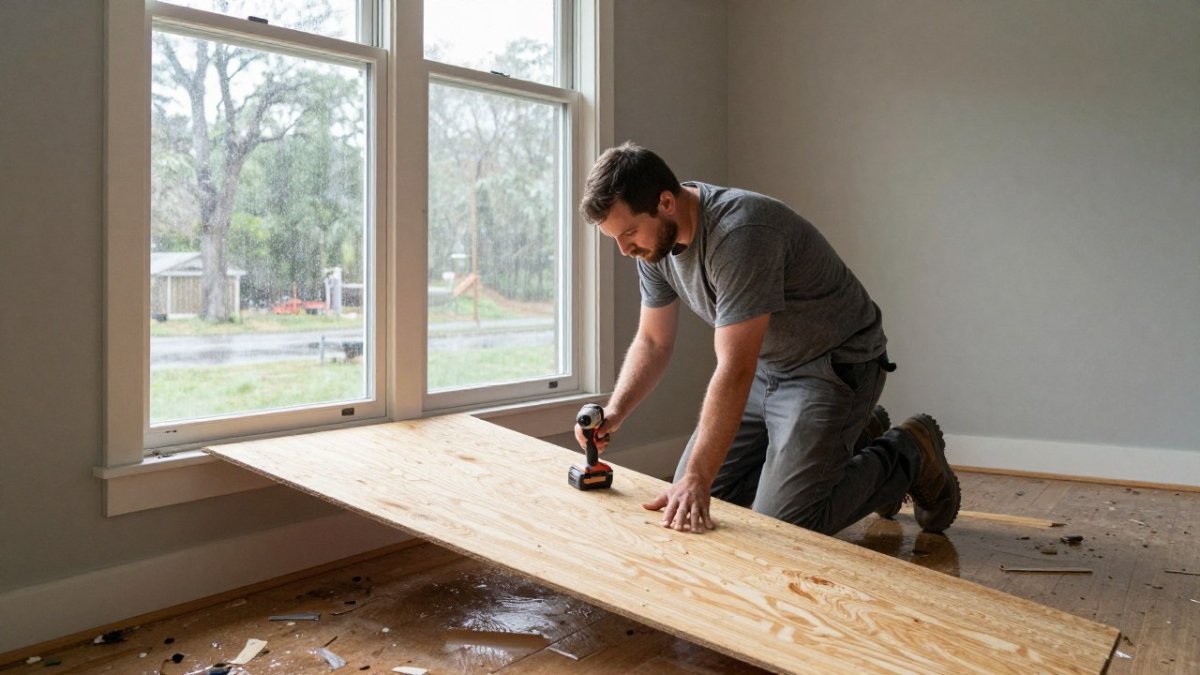
Most policies require you to prevent further damage after a loss, and often reimburse reasonable emergency repairs.
WRAL
Temporary repairs stop water and secure the structure, not fix it, holding the line until your claim is approved and permanent work can begin.
Priority order for emergency repairs:
Roof: Tarp any breach to stop water intrusion. Use weighted edges, not nails, so you don't create new holes.
Windows and doors: Board them up. Water and wind entering here cause interior damage that compounds fast.
Water intrusion: Extract standing water and start drying within 24 to 48 hours to prevent mold.
Debris: Clear what blocks access, but leave structural debris for the adjuster to see.
Keep every receipt. Emergency repairs are usually reimbursable, but only if you can prove what you spent. Photograph the "before" state of anything you cover or board up.
Storm Damage Roof Repair and Hidden Moisture Issues
Storm damage roof repair is where hidden problems hide. A missing shingle is obvious.
The difference between a quick patch and a lasting repair is moisture testing. A qualified roofer or restoration contractor uses a moisture meter on attic sheathing, ceiling drywall, and wall cavities, not just the roof surface.
Signs of hidden moisture damage:
Dark stains on ceiling drywall, even faint ones
A musty smell in the attic or upstairs rooms
Soft spots in roof decking when you press on it
Mold can begin growing within 24 to 48 hours of water exposure, so drying and dehumidifying must start immediately after the leak stops (the EPA).
Key Takeaway Surface repairs without moisture testing are how homeowners end up redoing the same roof two years later. Insist on moisture readings before anyone closes up a wall or ceiling.
Storm Damage Repair Cost and What Drives It
Storm damage repair cost depends on scope, not square footage. Two same-sized homes can see wildly different bills because one has hidden water damage and the other doesn't. To understand your number, know what each line item represents and how insurers and contractors price it.
How Storm Repair Estimates Are Actually Built
A repair estimate is a stack of line items, not a single number. Most insurers and contractors use Xactimate or Symbility, both of which pull unit prices from regional cost data updated monthly, which is why two contractors in the same metro can differ by 10 to 20 percent on the same scope.
Each line item typically has three components:
Materials: Shingles, siding, drywall, lumber, paint, and fasteners, priced per square, per sheet, or per linear foot.
Labor: Measured in hours or units (a "square" of roofing is 100 square feet), with rates that vary by trade and region.
Overhead and profit (O&P): A markup, commonly 10 percent overhead plus 10 percent profit, applied when a job involves three or more trades or a general contractor managing subs.
Compare line items, not totals. A lower total often means a shorter scope, not a better price.
The Main Cost Drivers
Extent of structural damage: Cracked foundation or compromised load-bearing walls push a repair into rebuild territory. A structural engineer's report, typically a few hundred to a couple thousand dollars, is often required before a permit is issued.
Water intrusion depth: Drying and mold remediation add significant scope. Category 1 (clean water) drying is cheapest; Category 3 (black water from sewage or ground flooding) requires removing porous materials and antimicrobial treatment.
Materials and matching: Matching existing siding, roofing, or flooring costs more than a full replacement in one material. Discontinued products can force a partial or full re-roof or re-side to keep the elevation uniform.
What Homeowners Usually Pay Out of Pocket
Even a fully covered claim rarely pays 100 percent. Expect these gaps:
Deductible: Your policy's deductible applies. Wind and hail deductibles are often a percentage of the dwelling limit (commonly 1 to 5 percent), so a $400,000 home with a 2 percent wind deductible carries an $8,000 deductible.
Betterment and upgrades: If code requires a newer, pricier material than what was damaged, the insurer may pay only for like-kind-and-quality replacement, leaving you the difference.
Non-covered perils: Flood damage is excluded from standard homeowners policies. If storm surge or rising water caused it, only a separate flood policy (FEMA's National Flood Insurance Program or a private carrier) responds.
Getting an Estimate You Can Trust
Because pricing varies so much by scope, we don't quote numbers until we've walked the property. Any contractor who gives a firm price over the phone before seeing the damage is guessing, and the guess usually lands on your side of the ledger. Ask for an itemized written estimate separating labor, materials, and allowances, and compare it line by line against your adjuster's scope of loss.
Pro Tip Ask each contractor whether their estimate was built in Xactimate or Symbility and whether they'll share the file. Contractors who work with insurers routinely will say yes. Those who won't may be pricing by feel, which makes supplements and change orders much harder to justify later.
Storm Damage Restoration Timeline: From Claim to Completion
A storm damage restoration timeline runs longer than most homeowners expect, and the delays usually aren't the contractor's fault. What most guides skip is the insurance-claim clock running underneath the construction schedule. Miss a step there and the project stalls, no matter how fast your crew is.
The Claim Timeline, Step by Step
Phase | What Happens | Typical Duration |
Claim filed | Report loss, get claim number and adjuster name | Day 1 |
Adjuster contact | Adjuster calls to schedule inspection | 1-5 days |
Adjuster inspection | On-site damage assessment and measurements | 3-10 days from filing |
Scope of loss issued | Itemized document listing what the insurer will pay | 1-3 weeks after inspection |
Contractor estimate compared | Your contractor's line items reconciled against the scope | 1-2 weeks |
Supplement filed (if needed) | Additional hidden damage added to the claim | 1-4 weeks per supplement |
Payment issued | Initial check or ACH for the undisputed scope | 1-2 weeks after scope agreement |
Permits | Local jurisdiction review and issuance | 1-4 weeks |
Repair work | Licensed crews complete the agreed scope | 2-8 weeks |
Final inspection | Code compliance sign-off | 1-2 weeks |
Recoverable depreciation released | Second payment after work is complete | 1-3 weeks after final invoice |
What Each Step Actually Requires From You
Filing the claim. Report the loss as soon as your household is safe.
The adjuster visit. Be present if you can. Walk the adjuster through every room and point out documented damage.
The scope of loss. This itemized document drives everything. Read it line by line against your photos and your contractor's estimate.
Supplements. A supplement formally requests adding damage the original scope missed.
When the Claim Goes Sideways
If your claim is underpaid or partially denied, you have options, none require accepting the first answer:
Request a re-inspection. New evidence, like moisture readings or an engineer's report, often changes the outcome.
Ask for the denial in writing. Most states require the insurer to state the policy language and facts behind a denial. That written reasoning is what you appeal against.
Use the appraisal clause. Most policies include one for disputes over a covered loss's value. Each side hires an appraiser; the two pick an umpire if they can't agree. Usually faster and cheaper than litigation.
Watch Out Watch the clock on deadlines. Many policies require you to file suit within a set period after the date of loss, often one to two years, and some states shorten that for storm claims. The appraisal clause and the suit deadline are different clocks, and missing either can end your options.
Why the Two Clocks Rarely Line Up
The construction and claim schedules run on different engines. Your contractor can be ready on day ten while the scope of loss is still in review.
The fix is sequencing: emergency tarping and drying happen immediately; permanent repairs wait until the scope is agreed or a supplement is filed. That keeps the claim defensible and stops crews tearing into work the insurer hasn't priced.
Key Takeaway The two phases that surprise homeowners most are supplements and recoverable depreciation. Supplements add time but usually add money. Recoverable depreciation adds money but only after the work is done and invoiced. Plan cash flow around both.
Choosing a Licensed Contractor and Avoiding Storm Repair Scams
Storm repair scams follow storms the way gulls follow fishing boats.
Vetting a contractor takes ten minutes and saves months of headaches. Verify these before signing anything:
License: Check license status with your state licensing board.
Insurance: Ask for a certificate showing general liability and workers' comp, then call the insurer to confirm it's current.
Local address: A physical business address, not just a phone number and magnetic sign.
Red flags: pressure to sign today, cash-only demands, no written contract, out-of-state plates with no local office, and anyone who offers to "handle" your insurance claim for you.
We communicate directly with your adjuster as part of our claim assistance, so you don't spend evenings on hold with the insurance company.
Federal Trade Commission guidance on avoiding home repair scams outlines the warning signs and your recourse if you've been targeted.
Frequently Asked Questions
What should I do immediately after storm damage to my house?
Check for safety hazards first: downed power lines, gas leaks, and structural instability. If you smell gas or see sparking, leave and call 911. Once safe, photograph all damage before making temporary repairs. Contact your insurance company within 24-48 hours to start your homeowners insurance storm damage claim. Keep receipts for emergency repairs like tarps or board-up, as these are often reimbursable.
How long does storm damage restoration usually take?
The storm damage restoration timeline varies by severity. Minor repairs like roof patching or window replacement may take 1-2 weeks. Moderate damage involving water extraction, drying, and interior repairs typically runs 4-8 weeks. Major structural damage or full rebuilds can take 3-6 months or longer, especially if permits and code upgrades are required. Your contractor and insurance adjuster can give a more specific estimate after assessment.
Will filing a storm damage claim make my insurance rates go up?
Not always. Many states, including North Carolina, prohibit insurers from raising rates for claims resulting from a single weather event that affects a wide area. However, filing multiple claims in a short period can lead to surcharges or non-renewal. Check your policy and speak with your agent about how a specific claim might affect your premium before filing.
Should I hire a restoration company or a general contractor?
A restoration company specializes in emergency mitigation (water extraction, drying, board-up) and often works directly with insurance adjusters. A general contractor handles the rebuild and renovation. For storm damage, you may need both: a restoration company for immediate mitigation, then a licensed contractor for repairs. Some full-service firms like Rapid Refurb manage both phases, simplifying communication with your insurer.
Can I upgrade my home while repairing storm damage?
Yes, but insurance typically pays only to restore your home to its pre-storm condition. If you want upgrades like impact-resistant windows, better insulation, or updated finishes, you pay the difference out of pocket. Some homeowners use the repair process to make hurricane-resistant upgrades that may lower future insurance premiums. Discuss upgrade options with your contractor before work begins.
How do I avoid storm repair scams?
Never hire a contractor who knocks on your door unsolicited, demands full payment upfront, or pressures you to sign immediately. Verify their license and insurance through your state's licensing board. Get at least three written estimates, check references, and insist on a detailed contract with a payment schedule tied to milestones. Legitimate contractors do not ask for large cash deposits or offer to 'handle' your insurance claim for you.
Get Quote



Comments